
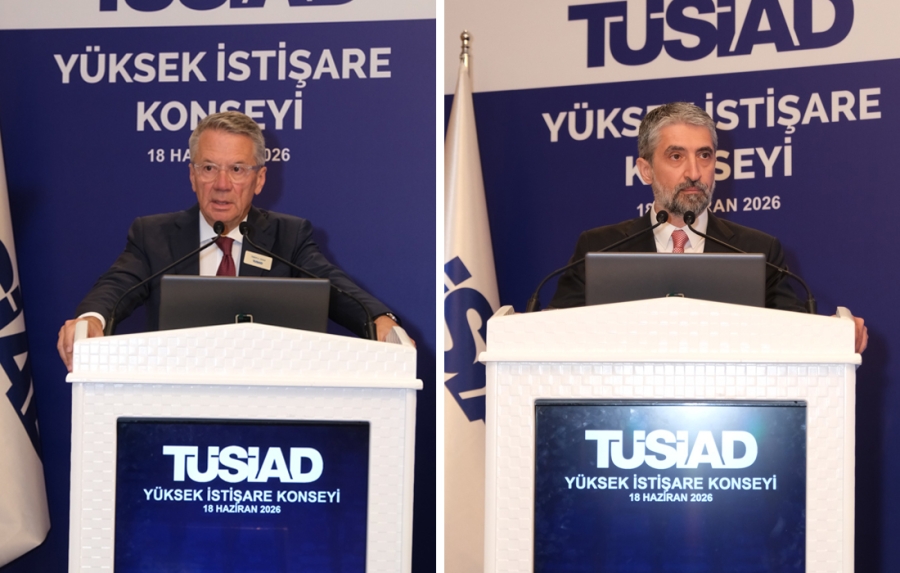
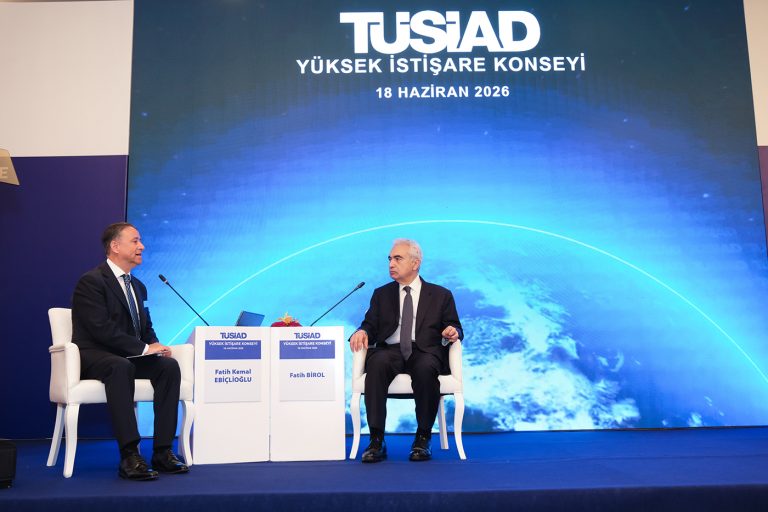
The High Advisory Council of the Turkish Industry and Business Association (TÜSİAD) convened in İstanbul on June 18, 2026. The High Advisory Council is a biannual deliberative conference where the business world takes stock of domestic and global political and economic developments and offers suggestions to policy makers from a business perspective. Opening remarks were delivered by TÜSİAD High Advisory Council President Ömer Aras and TÜSİAD Board of Directors President Ozan Diren. The Executive Director of International Energy Agency (IEA), Dr. Fatih Birol, delivered a keynote address. Following his remarks, a session was held with Fatih Birol, moderated by TÜSİAD Vice President Fatih Kemal Ebiçlioğlu.
The meeting also featured the presentation of the sectoral results of the TÜSİAD Cost-Based Competitiveness Index. The presentation session was moderated by TÜSİAD Chief Economist Gizem Öztok Altınsaç, with the participation of Prof. Dr. Hakan Kara of Bilkent University, Dr. Şeref Saygılı, co-founder of Saha Analytics, and Oğuz Atuk, co-founder and CEO of Saha Analytics. During the session, data on the 10 sectors covered by TÜSİAD Cost-Based Competitiveness Index were presented for the first time and the dynamics affecting competitiveness were discussed at the sectoral level.

Excerpts from the opening remarks are below:
Remarks by TÜSİAD High Advisory Council President Ömer Aras
On global transformations:
“We are living in an era in which major geopolitical, technological, and energy-driven transformations are intertwined with shifting trade and industrial policies.”
“The fundamental issue before us is the institutional capacity with which companies can respond to this pace of change. It is also how countries can generate resilience against shocks. As a result of recent events, we have seen that economic calculations and geopolitical developments can no longer be considered separately. Today, investment decisions are not made solely by looking at economic data. Energy security, supply security, technology access, and geopolitical risks are considered together. Because the world we live in is now more fragile, more fragmented, and more uncertain.”
“There are three important root causes behind the uncertainties we are experiencing today. The first root cause is that military power and production power are no longer in the same place; they have diverged. Over the past twenty-five years, the center of gravity of global production has rapidly shifted eastward. Today, production superiority lies with China, while financial and military superiority still lies with the U.S. This divergence creates a major fault line in the backbone of the world economy.”
“The second major root cause behind the uncertainties we are experiencing is the energy transition. The world is still dependent on oil and natural gas. When the Strait of Hormuz closes, oil prices rise. The cost structure of industry is disrupted. At the same time, however, a significant transformation is also taking place. Solar and wind energy are now becoming cheaper than fossil fuels in many regions. For this reason, green energy is not only a new source of energy; it implies global competitiveness and national security.”
“The third major root cause of the uncertainty we are experiencing is technological transformation. Developments in robotics and artificial intelligence are reshaping modes of production, business models, state strategies, and global competition. Today, three critical elements come to the fore for artificial intelligence: chips, energy, and data. Chip design, the machines used in chip manufacturing, and chip production are carried out by a very limited number of companies in different regions. The energy required for artificial intelligence is increasing rapidly. Data, meanwhile, is becoming a strategic asset. Therefore, technological competition is not only economic; it is also turning into a geopolitical struggle.”
On Türkiye’s need for economic resilience:
“In this period, we must grow by strengthening our economic resilience. However, economic growth alone is not enough. How we grow, and whether growth creates development, is also important. Türkiye’s new development story should be built on higher productivity, higher value added, stronger technology capacity, more competent human capital, and a more resilient economy.”
“Economic success is not only a matter of resources. It is also a matter of direction. It is not possible for a country to do every task best at the same time. Türkiye, too, needs a shared sense of economic direction in the period ahead. What matters is being able to focus on areas where there is competitive advantage. In which sectors will we deepen our capabilities? In which technologies will we develop capacity? Which of our regions will specialize in which area of production? Which logistics corridors will we integrate into? We must think about these questions with a long-term perspective.
“Besides we must equip the youth with quality education, continuously develop employee competencies, and tap the full potential of women in every area of economic and social life.”
“There are great opportunities before us, because our country has important advantages. The first is our geographic location. We are at the intersection of energy routes, trade corridors, and production networks, next to the European Union and on the threshold of Asia. The second, is our production capability. Türkiye is not merely a consuming economy. It is a country with the capacity to produce industry and services. The third is our economic diversity. We have agriculture. We have industry. We have tourism. We have health infrastructure. We have logistics strength. We have significant capacity in the defense industry. This diversity is an important advantage that can give Türkiye resilience.”
On Türkiye-EU Relations:
“One of our most important strategic economic objectives should be the modernization of the Customs Union with the European Union. Because Türkiye’s future should be located not outside, but inside, the EU production architecture. Türkiye should be a natural part of the ‘Made in Europe’ approach that is gaining increasing strength in the EU. This is of critical importance for the healthy, efficient, and competitive growth of our industry.”
“Today, the EU is rebuilding its new industrial order around energy transition, defense, digitalization, supply security, and strategic production. As the EU undergoes this change, Türkiye cannot remain outside this transformation. On the contrary, with its geographical location, production capacity, and industrial experience, it should be one of Europe’s most important production partners. Türkiye’s stronger inclusion in the European Union’s integration and enlargement process is important not only for Türkiye, but also for the competitiveness, resilience, and global influence of the EU. For this reason, the EU should begin the Customs Union modernization process without letting political obstacles stand in the way.”
“As the world is being reshaped today, countries that wait and merely try to get through the day will lose. Countries that read uncertainty correctly can think long term, determine their direction, develop their human capital, strengthen their institutions, invest in technology, and build resilient economies will prevail. Success in the new period requires common purpose, a long-term perspective, and strong coordination. Türkiye must secure a solid place in the production, energy, and technology architecture of the new period.”
“In an environment marked by all these transformations and tensions, the second half of 2026 will be very important for Türkiye not only economically but also geopolitically. Two critical international summits will take place in our country by the end of this year. In July, we will host the NATO Summit, and in November, we will host the COP 31 Climate Summit. These two summits in fact represent two major transformations the world is undergoing.”
“The NATO Summit shows us the following: The world is seeking a new security foundation. Military balances are changing. Alliance structures are being discussed anew. Energy security, technology security, and supply security are now becoming inseparable parts of defense policies. In such a period, it is becoming clear that Türkiye is one of NATO’s most important members not only militarily, but also economically, geopolitically, and strategically. We are located in a highly critical region, from the Black Sea to the Middle East and from energy corridors to logistics routes.”
“In the period ahead, the boundaries between security and the economy, defense and industry, and geopolitics and technology will become increasingly intertwined. The role Türkiye will assume in this new equation is of critical importance for NATO’s transformation and the shaping of the transatlantic security architecture.”
“The COP 31 summit, meanwhile, reminds us of another truth: Climate change is no longer merely an environmental issue. It affects the economy, agriculture, migration movements, human health, energy investments, and finance. In the period ahead, climate-related risks will become one of the most important determinants of the world economy. For this reason, the COP 31 meeting to be held in Antalya is not only a diplomatic organization for Türkiye. It is also an important opportunity to show what kind of vision Türkiye will present in the areas of energy transition, green industry, sustainable finance, and regional cooperation. We must make good use of this.”
Remarks by TÜSİAD Board of Directors President Ozan Diren
On global transformations:
“Competitiveness arises not only from low-cost production, scale, or geographical advantage, but from data, technology, artificial intelligence, clean energy, skills transformation, and productivity. An industrial product is no longer only a physical product; it gains value together with software, data, services, design, brand, financing, and the ecosystem. Artificial intelligence and automation are changing all business models, from production to logistics and from sales to finance. We need companies and countries that manage this transformation rather than merely observe it.”
“The transition to industrial society brought humanity a major leap in production and wealth; however, humanity fell short in the test of sharing this leap fairly and inclusively. In this phase of the transition to the Information Society, we face the risk of a similar mistake. This is why keeping pace with today and preparing for tomorrow are important: this time, the transformation must be built on a foundation where not only the strongest prevail, but the full potential of society is mobilized.”
“We are in a period in which protectionism, absence of rules, unpredictability, and polarization are gaining strength around the world. Yet what humanity needs today is a more qualified understanding of democracy that strengthens human rights, inclusive institutions, and social consensus. Because inclusive institutions mean a stronger economy. Predictability and the rule of law means stronger investment. A broader space for freedoms means greater innovation capacity.”
On TÜSİAD’s global vision:
“Our global vision is not limited to Europe. Alongside the relations we develop with the United States, China, India, Africa, the Gulf countries, the Turkic Republics, and our region; the human capital formed by Turkish professionals that has spread across the world also contributes to Türkiye’s global competitiveness.”
“It is important to deepen our relations with the United States on technology, innovation, defense, and high value-added investments; and to address our relations with major economies such as China and India in a more balanced, higher value-added framework that strengthens production integration.”
“We should view the Middle Corridor, which encompasses the transportation, energy, digital, regulatory, and institutional dimensions of connectivity, as a strategic initiative that goes beyond the definition of a regional project and supports economic integration and supply chain resilience between Europe and Asia. We can develop our relations with the Gulf countries not only from the perspective of capital flows, but also with the perspective of establishing complementary partnerships in energy transformation, food security, and other value-added sectors.”
On Türkiye – EU relations:
“The modernization of the Customs Union should be launched without any delays due to technical or political preconditions… This is a key step that will modify the economic integration between Türkiye and the European Union to the needs of the new period.”
“EU-Türkiye integration must move beyond fragmented and merely functional headings and be placed within a strategic framework that encompasses the modernization of the Customs Union, green and digital transformation, industrial and technology cooperation, energy, transportation, defense, and innovation. We emphasized that Türkiye, as an EU candidate country, a Customs Union partner, and a NATO ally, is an integral part of Europe’s economic, industrial, and security architecture; and that a stronger common future can be built only through political will, regulatory alignment, and concrete steps.”
On Türkiye’s economic resilience:
“One of the strongest characteristics of our business world is the agility and resilience it has demonstrated repeatedly in different periods. In recent years, our companies have faced many tests, from the global pandemic to regional wars, from fluctuations in energy prices to difficulties in accessing finance, and from supply chain disruptions to sudden changes in markets. Each time, they demonstrated the ability to adapt quickly, develop alternative markets, maintain production, protect employment, and keep export connections alive.”
“This agility is a very important advantage for the Turkish economy. However, in the new period, reacting quickly to crises alone will not be enough. We need to combine agility with strategy, resilience with productivity, entrepreneurship with institutional capacity, and production power with technology and sustainability.”
“Companies no longer compete only on the basis of costs. The competitiveness of companies is now shaped by data use, technological capacity, qualified human capital, access to clean energy, brand, design, access to finance, institutionalization, and the ability to manage global networks.”
On domestic economic and industrial policy:
“…we must support our disinflation target with complementary tools that address production, exports, and industrial transformation. The real sector needs not only financing, but also a sense of direction strengthened by the public sector’s supportive and guiding role. Together, we must define which areas we will compete in over the next five, ten, and fifteen years; which technologies, sectors, export markets, and capabilities we prioritize. We must establish a clear framework on issues such as the effects of the EU’s Free Trade Agreements, the future of our economic relations with countries such as China and India, and Türkiye’s position in new global value chains.”
“As industrial and services policies are being redefined around the world, Türkiye also needs a selective, transparent, data-driven, and performance-oriented approach to industrial transformation. This approach requires the public sector, business world, academia, and civil society to act quickly with common sense. Strategic priorities must be clear.”
“The green transformation is not only an environmental policy. It is also a matter of market access, financing costs, export capacity, and competitiveness. Decarbonization investments, energy supply security, clean production technologies, and the circular economy will be decisive for the future of Turkish industry. Accelerating clean energy investments, strengthening grid infrastructure, increasing energy efficiency, and facilitating access to finance are the building blocks of a competitive industry.”
“The most important dimension of these transformations is human capital. Digital and green transformation can achieve lasting success only through the skills transformation of our people. We must place the education system, next-generation vocational training, lifelong learning, and the participation of young people and women in the workforce at the center of the new understanding of competitiveness. We should view these transformations not as a cost item, but as an opportunity that will renew competitiveness, reduce risks, and create Türkiye’s new areas of growth, investment, employment, and technology.”
“To transform these opportunities into lasting success, we must achieve several things simultaneously. We must be determined in the fight against inflation and protect our production and export capacity. We must accelerate industrial transformation, carry out skills transformation, and adapt to the digital and green economy. We must deepen integration with the EU and expand our global networks. We must strengthen the ground of trust in institutions, predictability, and a rules-based market order. While doing all this, we must place social welfare and inclusive development at the center. This task does not belong solely to the public sector, solely to the private sector, solely to academia, or solely to civil society. It is the common responsibility of all of us.”