
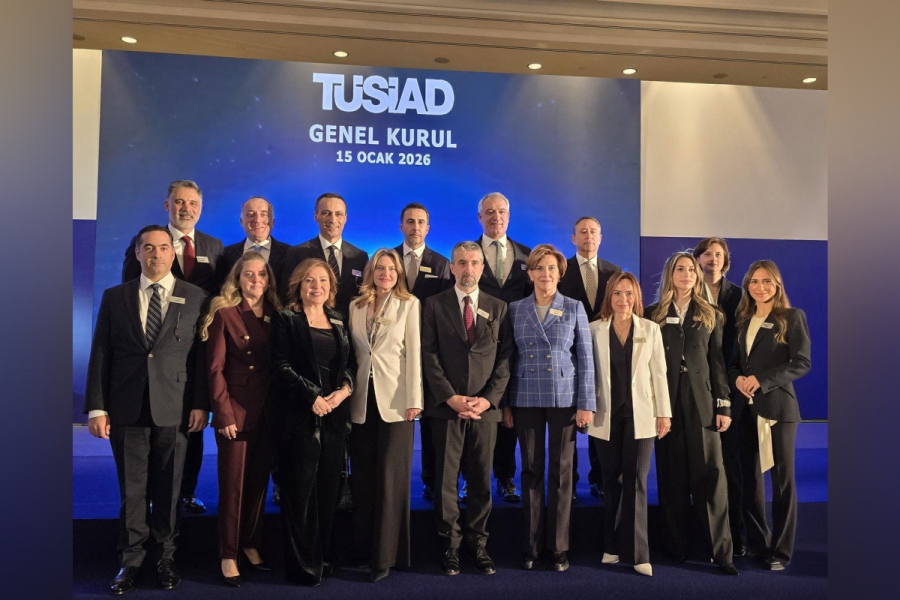
The General Assembly of the Turkish Industry and Business Association (TÜSİAD) convened in Istanbul on January 15, 2026 to elect the Board of Directors. Ozan Diren was elected as the President of TÜSİAD. Perihan İnci, İzzet Özilhan, and Fatih Kemal Ebiçlioğlu were elected as Vice Presidents. Ömer Aras was re-elected as President of High Advisory Council.
Rahmi M. Koç, TÜSİAD Honorary President presented a plaque of appreciation to Orhan Turan, who served as President of Board of Directors of TÜSİAD during the 2022–2025 term.
Fredrik Persson, President of BusinessEurope also delivered remarks during the event.
The Board of Directors elected by the TÜSİAD General Assembly are as follows:
TÜSİAD BOARD OF DIRECTORS (2026-2027):
- OZAN DİREN, President
- PERİHAN İNCİ, Vice President
- İBRAHİM İZZET ÖZİLHAN, Vice President
- FATİH KEMAL EBİÇLİOĞLU, Vice President
- MELTEM USLU AKOL
- ELİF ÇOBAN
- AZMİ GÜMÜŞLÜOĞLU
- ASLI GÜREŞÇİER
- ŞERAFETTİN KARAKIŞ
- ÖMER MERT
- AHU SERTER
- FEYYAZ ÜNAL
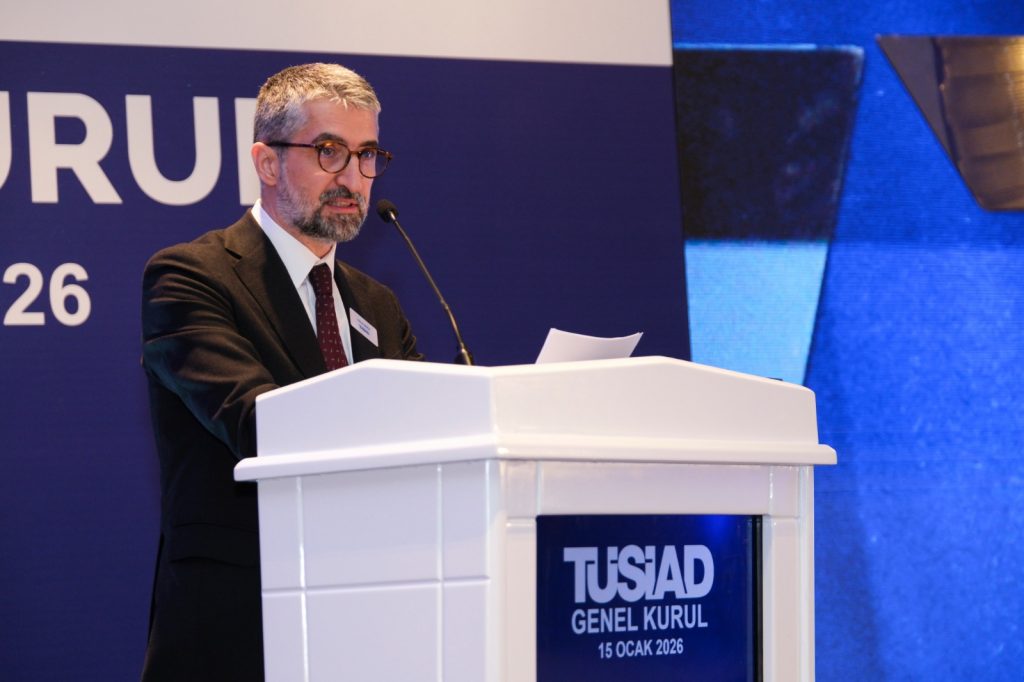
Ozan Diren delivered brief remarks during the General Assembly meeting, highlighting Inclusive Economic Development and Competitiveness as a core focus area during his term.
- “Over its 55-year deep-rooted history, TÜSİAD has not only represented an economic force that produces, creates value, and generates employment, but has also served as a strong point of reference for “collective wisdom” in our country’s development journey.”
- “In a world where balances are shifting, TÜSİAD is a compass—through its work that blends economic development and competitiveness with democracy and the rule of law—guiding the development path that will carry our country to the position it deserves.”
- “Bringing our country to a distinguished and leading position in the world is a shared responsibility we all have toward future generations.”
- “Fulfilling this responsibility requires building a common future that meets the needs of our times—on the basis of equality and without leaving anyone behind.”
Inclusive Economic Development and Competitiveness as Core Focus Areas
- “Today, the world stands at a historic turning point. As the global economy is reshaped by unpredictability and rapid change, we must strengthen our country’s competitiveness through greater and higher value-added production and exports and support an attractive investment environment with social and structural reforms. In doing so, we can position our country as one that stands out positively and takes a leading place in the world.”
- “To achieve this, we need to formulate a stronger, more competitive economic equation and prioritize development beyond mere growth. Development means that the country, and society in all its segments, attain higher living standards through inclusive growth and the fair distribution of income. In this direction, the main focus of our Board will be to address development through a multi-layered and holistic perspective. TÜSİAD’s accumulated experience and past work in this area will be our strongest foundation.”
- “The first pillar of our perspective is a competitive economy that is also people-centered and inclusive. We will address the economy not only by supporting monetary and fiscal policies with structural reforms, but also together with an agenda of social development and institutional strengthening—centered on equal opportunity for all, the advancement of human capital and skills, and fairness in income distribution.”
- “The second pillar is a realistic and competitive transformation. We must view the green transition and the digital transition not merely as trends, but as the unstoppable, productivity- and cost-driven realities of global competition. At the same time, we will keep the social impacts of this transformation—and our workforce’s needs for skills and competences — at the very center of the process.”
- “Our third pillar is a reliable investment climate. To finance development, establishing an attractive investment environment reinforced by the rule of law and predictability will remain our priority.”
The President of the High Advisory Council Ömer Aras delivered opening remarks:
On geopolitical developments that reshape dynamics of cooperation
- “Domestic political and economic developments within countries; the impact of geopolitical shifts on the global trade order; natural disasters driven by climate change; rapid technological advances; and the expanding role of AI in our lives are the main drivers of the major transformation we experienced in 2025. As history has shown many times, in periods of uncertainty, countries that position themselves correctly seize major opportunities, while those that misposition themselves can suffer serious setbacks.”
- “The global economy has moved to a more selective and more costly order. This is not a temporary wave. A new cost burden has been added on top of production and trade, and this new architecture is changing how competitiveness is measured. This transformation is crystallizing in three concrete areas:
- Geopolitics and sanctions regime: Wars, sanctions, and export tariffs are no longer external to trade; they are becoming embedded within it. Companies are no longer competing on price alone, but also on reliable delivery and consistent quality.
- Industrial policy regime: Major economies are relocating production. They want to produce critical inputs domestically and are tightening supply chains. They are managing technology development, access, and use as a strategic domain.
- Standards regime: Standards have become a prerequisite for market access. Carbon footprint, traceability, product safety, data security, and cybersecurity are not abstract goals—they are enforceable rules that can stop shipments at the border, cancel orders, and raise the cost of financing.”
- “Taken together, these three shifts are changing the metrics of global competition. Low-cost production alone is no longer enough; production must be reliable, measurable, and compliant with standards. In this new order, the relationship between growth and development becomes clearer: productivity moves decisively to the forefront, strengthening competitiveness and ensuring that growth translates into development.”
Productivity as the Core Component of Economic Development:
- “This period of heightened uncertainty can become an opportunity for Türkiye. By positioning ourselves correctly as a country—and by leveraging our regional advantages at home—we can reach our goals through a development model grounded in productivity.”
- “In the new global order, productivity must be the heart of growth. Without rising productivity, growth remains fragile. The fight against inflation becomes harder and longer; real wages do not rise; and prosperity gains do not materialize. Over time, a gap emerges between realized inflation and perceived inflation. If we can transition to productivity-based economic growth, we can achieve development as a country.”
- “Economic growth is a quantitative concept; it refers to an increase in national income. Development, by contrast, is qualitative — it implies structural transformation. It asks: “How are we living? Who benefits? What is the state of health, education, institutional quality, and income distribution?”
- “There can be no development without economic growth, but economic growth does not automatically create development. Development is the fair and sustainable diffusion of growth across society. Growth that generates development can only be achieved through productivity. That is why 2026’s central agenda should be a national productivity mobilization.”
- “Today, we must do better than our current production of goods and services. We must produce higher value-added, higher-quality goods and services that comply with EU standards, use high technology, and deliver more output with fewer resources.”
- “Productivity is the primary path for Türkiye to generate prosperity without inflation and to remain competitive globally. If productivity rises, real wages rise. If productivity rises, the current account deficit shrinks. If productivity rises, income distribution improves. For Türkiye, the issue is clear—we must recognize it.”
- “We have strategic advantages that can create competitiveness through higher productivity. We must use them rationally to achieve development. Let me give a few examples of these strategic advantages:
- Turning geography into economic power: Within a four-hour flight radius, there are 3 billion people—across Europe, the Middle East, Africa, and Central Asia. No other country has such a geographic advantage. In short, we have unique market access.
- A diversified industrial base: We have an industry capable of offering production variety and the potential to produce higher value-added goods, along with long-standing experience with integration into global supply chains.
- Defense industry momentum: We have taken major steps in the defense sector—an area the world currently needs and will invest heavily in the coming period. We must convert this rational strategy into a lasting competitive advantage by turning the defense industry’s innovation potential into cross-sector synergies.
- Agricultural land and irrigation capacity: If we can create productivity through rational investments in agriculture and livestock over the next decade, we can make a major leap toward development. We should approach agriculture and agro-industry with regional advantages in mind.
- Health services export potential: Especially for an aging Europe, we have the potential to deliver superior health services to surrounding countries. We should focus on elderly-care tourism as a significant service export and view health not only as diagnosis and treatment, but also as a broad industrial domain.
- Regional competitive advantages within the country: We have unique strengths such as sun-and-culture tourism. By providing value-added, productivity-enhancing services in complementary sectors like tourism and health, we can build competitive advantages.
- Human capital and education: Productivity in every sector requires a well-educated human resource. With the right education policies and equality of opportunity, we have the capacity to produce high value-added output with our high-potential youth. By strengthening our education infrastructure physically and technologically, we can reverse brain drain and turn education—like health—into an exportable service.
- Our areas of competitive advantage are not limited to these examples. The core point is that our development strategy should focus on areas where we already have a competitive edge. Producing efficient goods and services in these fields is easier and more sustainable. That is why productivity mobilization is simultaneously a competitiveness strategy, a growth strategy, and a development strategy.”
Outgoing President Orhan Turan expressed his gratitude to the Board of Directors, staff and TÜSİAD membership. He said, “TÜSİAD is more than a business association—it is the institutionalized embodiment of the business community’s collective mind.”
- “The business community does not only create value. It must also think, debate, and provide direction. And that is exactly why TÜSİAD exists. TÜSİAD is more than a business association—it is the institutionalized embodiment of the business community’s collective mind. It is this country’s idea factory, a future workshop working for tomorrow.
- “It is a civil society organization that:
- reflects on how our country should position itself in global competition,
- addresses economic development together with democracy, the rule of law, and institutions,
- and, while discussing today’s problems, aims to prepare for the world of tomorrow.
- “TÜSİAD’s mission has never been merely to take stock of the day; it has been to define tomorrow.
- “The world was changing rapidly: geopolitical balances have been shaken, global trade is being reshaped, and technology has fundamentally transformed the way business is done.
- “As the world changes so rapidly, we wanted to broaden our perspective. In looking at this period, we adopted an approach that considers four main axes together:
- the Republic and democracy;
- development and the environment;
- growth and distribution;
- the balance between the global and the local.”
Ozan Diren – Biography
Ozan Diren is a Board Member of Diren Holding and the CEO of DİMES, one of Türkiye’s leading beverage companies within the Diren Holding group. Diren graduated from the Department of Industrial Engineering at Istanbul Technical University in 1996. He earned a master’s degree in marketing from the University of Hartford in the United States in 1999 and later completed the Finance Specialization Program at Istanbul University’s Institute of Business Economics in 2011.
Diren began working at DİMES during his university years and has taken on active responsibilities at every level across all departments of the company. A TÜSİAD member since 2006, he served as a Member of the TÜSİAD Board of Directors and President of the TÜSİAD Agriculture, Food and Services Roundtable in the 2022–2023 term, and as a Vice President of the TÜSİAD Board of Directors in the 2024–2025 term. He was elected as the President of the TÜSİAD Board of Directors at the TÜSİAD General Assembly held on January 15, 2026.
In addition to his business career, Diren has long assumed various responsibilities in civil society organizations. His other roles include:
- TOBB (The Union of Chambers and Commodity Exchanges of Türkiye): Served as Chair of the Türkiye Beverage Council, a position to which he was unanimously elected in 2021 and held this role through 2026.
- MEYED (Fruit Juice Industry Association): Previously served as Chair of the Board of Directors.
- TÜRKONFED: Previously served as Vice Chair of the Board of Directors.
- Other Board Memberships: Served as a Board Member at IFU (International Fruit and Vegetable Juice Association), UNDP-B4G (Business for Goals), Wine Producers Association (ŞÜD), and the Turkish Dairy, Meat and Food Industrialists and Producers Association (SETBİR).