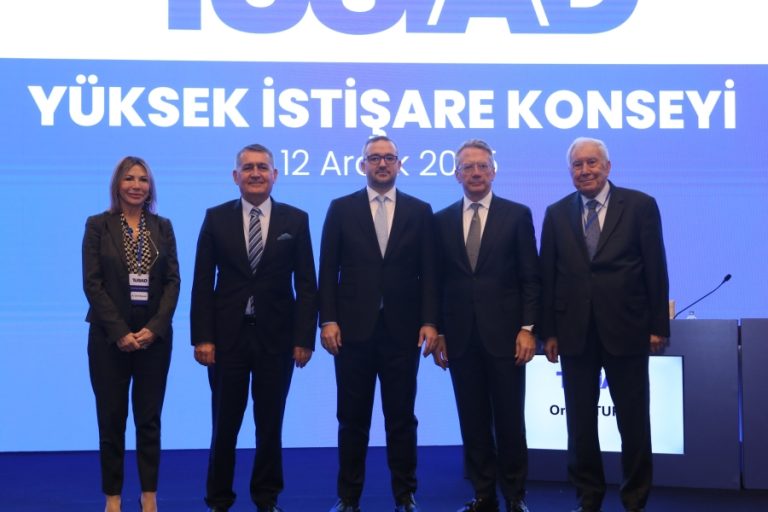
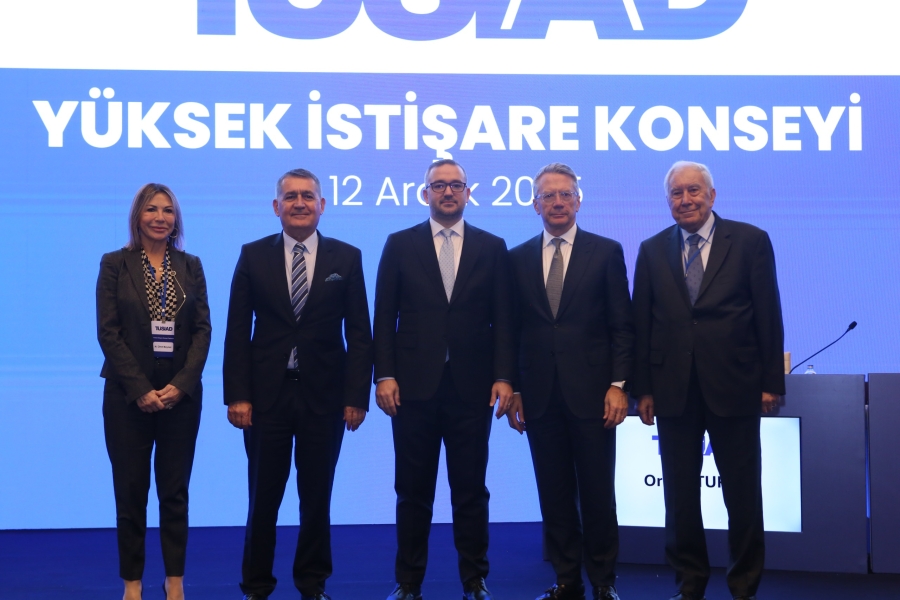
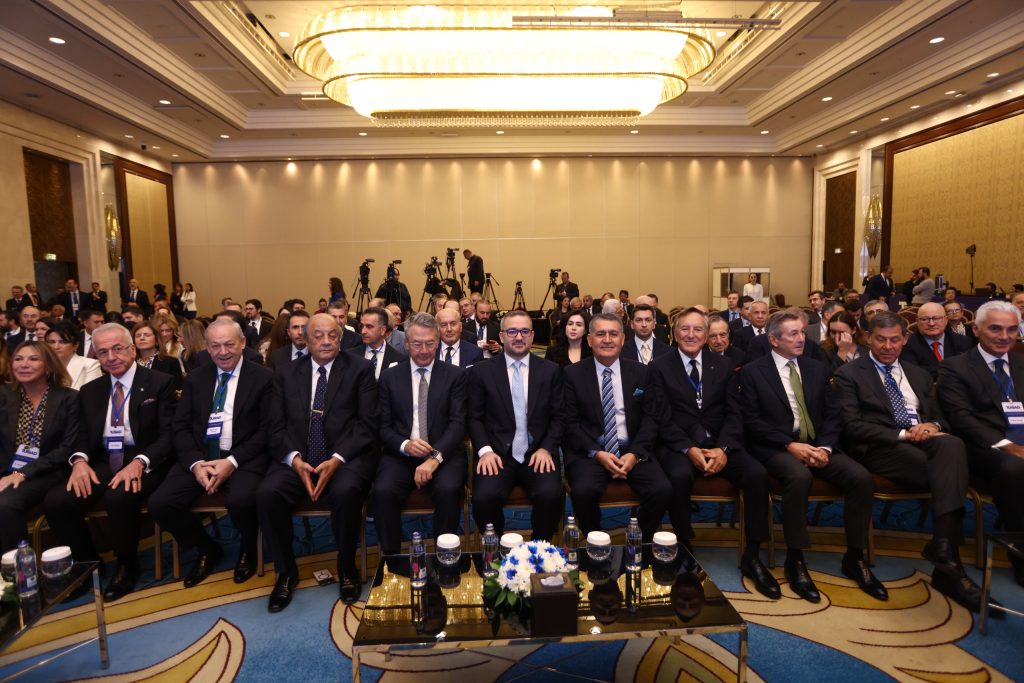
The High Advisory Council of the Turkish Industry and Business Association (TÜSİAD) convened in Ankara on December 12, 2025. The High Advisory Council is a biannual deliberative conference where the business world takes stock of domestic and global political and economic developments and offers suggestions to policy makers from a business perspective. Opening remarks were delivered by TÜSİAD High Advisory Council President Ömer Aras and TÜSİAD Board of Directors President Orhan Turan. The Governor of the Central Bank of the Republic of Türkiye, Dr. Fatih Karahan, delivered a keynote address.
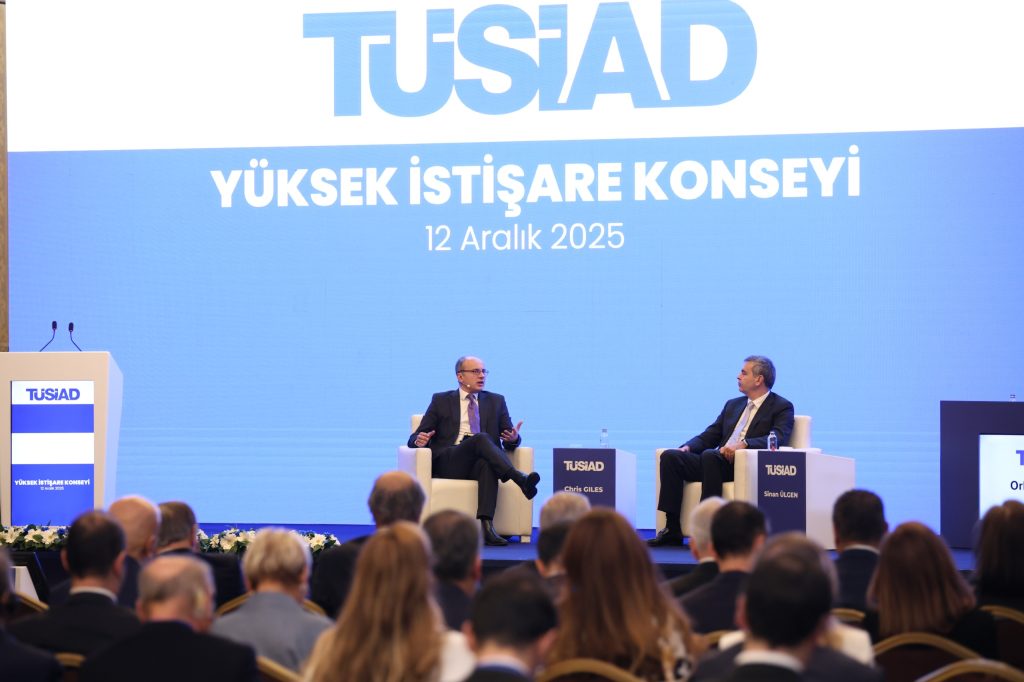
A panel discussion on Global Economic and Geopolitical Developments was held, moderated by Sinan Ülgen, Director of the Center for Economics and Foreign Policy Studies (EDAM), with the participation of Financial Times Economics Editor Chris Giles.
Excerpts from the opening remarks are below:
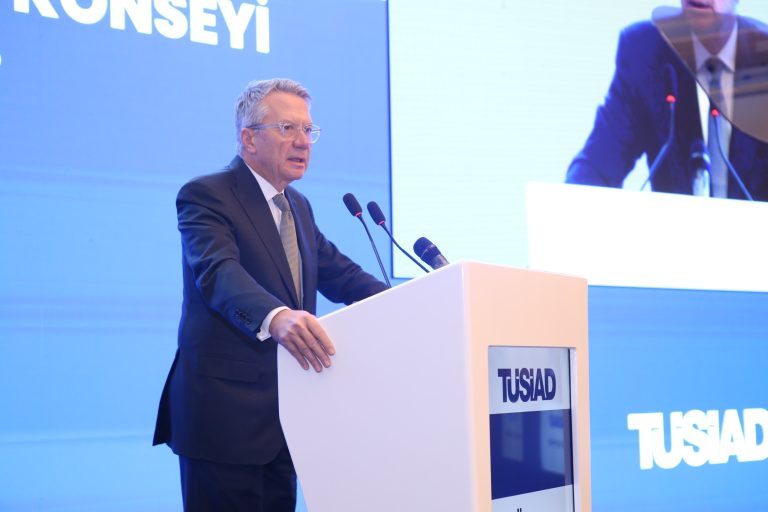
Remarks by TÜSİAD High Advisory Council President Ömer Aras
On the Economy and Technology
“The balance of power is shifting. Energy independence, the capacity to develop artificial intelligence technologies, and defense capabilities are emerging as the key drivers of employment and wealth creation. As economies transition toward electrification, the challenges of climate change and food security are deepening.
“… major advances are taking place in technology. We are struggling to anticipate the impact of ChatGPT and similar artificial intelligence applications on humanity—particularly on younger generations and the business world. This difficulty is not unique to us; the world as a whole is unable to fully grasp the scale of the transformation underway or the risks it may entail. The development of mechanisms to prevent the misuse of artificial intelligence is lagging behind.”
On Geopolitics and Trade
“Looking at recent global developments, disruptions in supply chains that began with the pandemic—followed by the Russia–Ukraine war, rising U.S.–China tensions, and more recent strains in U.S.–EU relations—have underscored the need for countries to stand on their own feet in strategically critical sectors.
“The wave of globalization that has shaped the past 30 years has now entered a new phase. As the rules-based global order weakens, the transaction-based policy approach pursued by U.S. President Trump is becoming more prominent. In other words, we are moving away from an international system grounded in shared principles toward one in which negotiations and bilateral deals increasingly define relationships.
“Countries are no longer competing solely on economic terms; they are also reassessing with whom they produce and whom they trust. The global economy is evolving toward a model of regionalized globalization. For Türkiye, a regional power, this transformation represents a major challenge—but also a historic opportunity.”
On Türkiye-EU Relationship
“In recent years, the European Union has been undergoing a quiet yet profound transformation—one that directly concerns Türkiye. This is because Türkiye is not a country whose relationship with Europe can be reduced solely to the EU accession process. Our economy, industry, energy networks, and trade channels are deeply intertwined with Europe and the EU Single Market. Yet we have not been able to establish the institutional and political ties that such interdependence requires.
“How can Türkiye strengthen its ties with the EU and secure a strong position in a multi-layered Europe? How can Türkiye move from being a country that merely observes Europe’s transformation to one that helps shape it? Today, Europe is no longer just a Union that sets rules; it is increasingly a structure focused on safeguarding its own economic security, technological leadership, and critical infrastructure. Even Brussels’ long-standing posture as a “rule-setter and lecturer” is now being questioned. Therefore, the issue is no longer only what the EU tells us, but how we define the partnership we seek under the goal of integration.
“With the Customs Union that entered into force in 1996, Türkiye became an integral part of EU and broader European supply chains and trade networks. Today, Türkiye is de facto a European economy. Approximately 41 percent of our exports go to the European Union. We are the EU’s fifth-largest trading partner. A significant share of foreign direct investment also originates from EU countries. Industrial standards, environmental and product regulations, artificial intelligence, data governance, digital market rules, the green transition, financial markets, and competition policies are largely shaped by EU norms. In an international order where the influence of middle powers is increasing, this mutual complementarity demonstrates the multiplier effect Türkiye can play within Europe’s strategic supply and competitiveness architecture.
“However, we also know that the rupture created by the EU’s accession of the Greek Cypriot Administration of Southern Cyprus in 2004 without a comprehensive settlement on the island, followed by the 2008 European debt crisis and the 2015 refugee crisis, effectively froze the accession negotiations that began in 2005. The Customs Union continues to function technically but cannot be updated due to political deadlock. Türkiye and the EU are tightly bound economically, yet distant in terms of institutional and political alignment. Despite all these challenges, the EU remains the most enduring element of Türkiye’s strategic international orientation. From the EU’s perspective, Türkiye represents the most tangible link of stability and complementarity in its neighborhood. Türkiye is not on Europe’s periphery; it lies at the very center of Europe’s energy security, migration management, and regional stability. This relationship, spanning more than half a century, is one of the most stable yet also one of the most stagnant pillars of Türkiye’s foreign policy. Today, however, we face a genuine opportunity to redesign this relationship, as the European Union is now a transforming power space, redefining its borders and its influence.
“The declining predictability of the U.S.–Europe security relationship, rising pressure from China in manufacturing and critical raw materials, dependence on Russia in energy, and global technology and artificial intelligence rivalries have pushed Europe to rethink its security and competitiveness through its own capacities. Fragmentation at the global and transatlantic levels requires deeper internal integration within Europe. The EU is now placing the broader European continent at the center as a source of power for the new era. This transformation makes it necessary not only to update Türkiye’s relationship with the EU, but to rethink it from the ground up. In the new Europe, there are three main lines of transformation. First, Europe is redefining itself as a “security and resilience space,” where trade, defense, energy, food, cybersecurity, and artificial intelligence technologies are all part of the same security strategy. Second, Europe is reestablishing itself as a “production space,” aiming for strategic autonomy in critical sectors ranging from semiconductors to green technologies, from AI to electrification. The third transformation concerns the Single Market. Together, these three shifts strengthen the possibility of Europe rebuilding itself as a “Pan-European space.”
“A concrete illustration of this approach came on December 3, 2025 when the European Commission announced a new strategic framework titled “Joint Communication on strengthening Economic Security.” This framework focuses on:
- reducing strategic dependencies,
- attracting secure and high-quality investment to the EU,
- strengthening the defense and space industries,
- achieving leadership in critical technologies,
- protecting sensitive data and information, and
- ensuring the security of critical infrastructure.
“This transformation also defines a new framework for Türkiye.
“The year 2028 is of critical importance for Türkiye if it seeks to deepen its integration into the Single Market. If we want to play a role in the future of the Single Market, the next three years are crucial. Türkiye’s position in this chain will no longer be determined by low-cost production, but by value-added manufacturing, digitalization, green energy, and efficiency.
“Through its investments and production capacity in the defense industry, Türkiye can play an important role in Europe’s new defense architecture. In addition, Turkish and European companies can cooperate on development and reconstruction projects in third countries and regions such as Syria, Ukraine, Gaza, and Africa, enabling them to compete more effectively with global players.
“Partnerships between our business community and companies across different European countries, as well as TÜSİAD’s presence within BusinessEurope, will be critically important in the Single Market integration process that will take shape over the next three years. At the same time, as the business community, we must closely monitor regulations such as the European Green Deal that shape the dynamics of trade. Through effective carbon management, we must enhance our competitiveness in the European market.
“Trust built through reform, alignment with norms, effective diplomacy, and productivity-focused technological development will be the key to entry into the new Europe. While preserving our regional capacity, we must deepen our integration into European networks. Without abandoning the goals of full membership and the modernization of the Customs Union, we should redesign our relations on the basis of “mutual benefit and shared interests.” Preserving the legal and institutional framework as we move forward is critical in the face of accelerating global transformation.
“As Europe is reshaped, we must protect the infrastructure that enables our participation in decision-making processes and strengthens our negotiating power. In this direction, we need to define a comprehensive alignment and action roadmap across all strategic areas. Only then can we deepen Türkiye–EU strategic cooperation and firmly reinforce Türkiye’s central role in building a safer, more competitive, and more resilient Europe.
“Türkiye–EU relations stand at the threshold of a new era. In this new phase, the question is no longer simply, “Will Türkiye join the EU?” but rather, “Where will Türkiye stand in the future of Europe?” The answer is ours to give.”
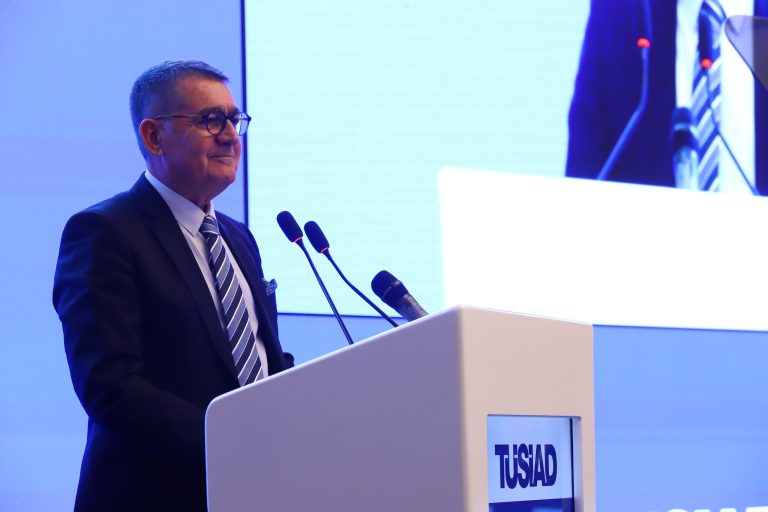
Remarks by TÜSİAD Board of Directors President Orhan Turan
“Over the past two months, we have held an intensive series of engagements with representatives from a wide range of sectors—including investors, entrepreneurs, R&D centers, academia, business associations, the bureaucracy, and central and local political actors—in Qatar, Brussels, Shenzhen, Guangzhou, Boston, New York, and Paris. We will be in London next week as well. In just 18 days, we conducted 72 visits and met with more than 200 individuals. During these engagements:
- In New York, we discussed the U.S. and global economy with business and financial circles.
- In Boston, we explored the technology, education, and innovation ecosystem, as well as artificial intelligence, industrial policy, and trade policy, with students and academics.
- We examined China’s technology development model firsthand and exchanged views on potential areas of cooperation between the two countries.
- In Brussels, we articulated Türkiye’s legitimate positions to the European Parliament and the European Commission.
- In France, we discussed the priorities of Türkiye–France economic relations within the EU framework, as well as opportunities for cooperation in third countries.
- In Qatar, we considered ways to enhance mutual cooperation in areas such as financial services, the investment climate, and digital transformation.
- Across all our engagements in Europe, we emphasized that including Türkiye in the competitiveness-oriented initiatives emerging in the new period is of critical importance for both the EU and Türkiye, particularly in terms of shared resilience and supply chain security.
On the United States
“During our engagements in the United States, we observed that concerns stemming from the prevailing uncertainty surrounding both the global and U.S. economies dominated the agenda. The U.S. economy faces challenges such as a heavy debt burden, a tendency toward de-dollarization, and a modest uptick in inflation alongside a partial economic slowdown. Nevertheless, the United States remains the world’s strongest economy.
“One of the most frequently discussed topics during our U.S. meetings was technology. When innovation is viewed as a chain extending from discovery to commercialization, U.S. leadership in this field is clearly evident. In areas such as high technology, software, biotechnology, and space sciences in particular, the United States continues to be a major hub of global innovation. As part of the visit, we discussed the impact of artificial intelligence on business models and the opportunities it creates for the entrepreneurial ecosystem at a panel held in New York.
“Our engagements in the United States also highlighted that one of the most critical resources we need in order not to fall behind in competition or remain stagnant is the energy, creativity, and passion of our young people, entrepreneurs, and professionals who are spread across the world.”
On China
“In November, we visited China, which has now become the world’s second-largest economy. China is no longer merely a low-cost manufacturing base; it has also emerged as an innovation center. According to the Global Innovation Index, China now ranks as the tenth most innovative country in the world. We observed that China has achieved rapid progress in advanced technology fields such as robotics, aerospace, new energy equipment, biotechnology, electric vehicles, and advanced materials through clustering, strong R&D investments, and large-scale technology projects.
“Within the scope of our engagements, we visited leading technology companies and innovation centers and exchanged views on potential areas of cooperation between Türkiye and China in these fields. We emphasized that comprehensive partnerships could be developed in areas such as artificial intelligence, robotics, innovation, and supply chains. China’s manufacturing capacity and technological leap make it one of the most important actors in the new global architecture. At the same time, however, it is clear that challenges such as an export-dependent economic structure, rigid regulations, the party-state system, lack of transparency, weak domestic demand, deflationary pressures, and a declining population create risks and uncertainties for the sustainability of China’s economic performance.”
On the European Union
“As a Board, our most recent visit last week was to Brussels, the center of the European Union. We held meetings with Members of the European Parliament, the European Commission, representatives of EU member states, and officials of the Republic of Türkiye. Europe must reduce its external dependence in security, energy, and critical raw materials and technologies, while at the same time rebuilding its competitiveness. Although belatedly, the EU is attempting to emerge from this predicament by developing a new industrial narrative.
“In our engagements in Brussels, we emphasized that Türkiye is an integral part of the EU economy, security architecture, and institutional and legal system. We drew attention to the need for the proposed “buy European” approach to take into account Türkiye’s critical role in EU industrial and supply chains, and for the definition of “European” in product preferences to include Türkiye. As in all our engagements with the EU, we once again reiterated our position that the modernization of the Customs Union should be launched immediately, without political preconditions.
On Geopolitics & Trade
“The world is preparing to leave behind one of the most extraordinary years in recent history. Transformation and uncertainty have been the most frequently used words everywhere, by everyone, throughout this year. Indeed, we have lived through a year in which an old chapter of the global order closed and a new one opened. The changes we have experienced over the past few years have far exceeded those we witnessed over entire decades—and this transformation will continue in the years ahead.
“The era of globalization and rapid expansion in the world economy once made it easier for emerging economies to achieve high growth rates. However, in a slowing global economy and amid growing uncertainty in international trade policy, we are entering a period in which countries can no longer base their growth strategies solely on exports. We need to prepare accordingly.
“In the face of these unpredictable dynamics, what we must do is be proactive and work to shape developments in the direction we desire. Yet there are also changes we do not even realize we do not know—making the task even more difficult. Unprecedented developments are occurring simultaneously around the world:
- For the first time in history, the global population is both aging and shrinking.
- Artificial intelligence is preparing to substitute for human cognitive capacity.
- The prospect of global average temperatures exceeding the 1.5°C threshold is now on the agenda; for the first time in history, such warming would be driven by human activity.
“The convergence of these three forces could give rise to developments that are entirely beyond our current ability to foresee.
On Domestic Policy
“The business community should not have to devote all its time to managing the cycle of exchange rates, interest rates, and inflation, or to resolving financing constraints. Instead, it should be able to focus its energy on long-term investment and production decisions. Undoubtedly, the most critical condition for enabling this is bringing inflation down permanently to single-digit levels.
“However, while winning the fight against inflation is a necessary condition, it is not sufficient to take advantage of the opportunities that the new global order will present. Regardless of how the global economic system evolves, the fundamental attributes that make economies strong remain unchanged.
As we have long emphasized, Türkiye must:
- ensure the full and effective functioning of the institutions and rules of the market economy
- establish macroeconomic stability,
- complete structural reforms,
- increase the productivity of our companies,
- strengthen our capacity for technology development and innovation,
- make our education system globally competitive, and
- unlock and empower the full potential of women.”